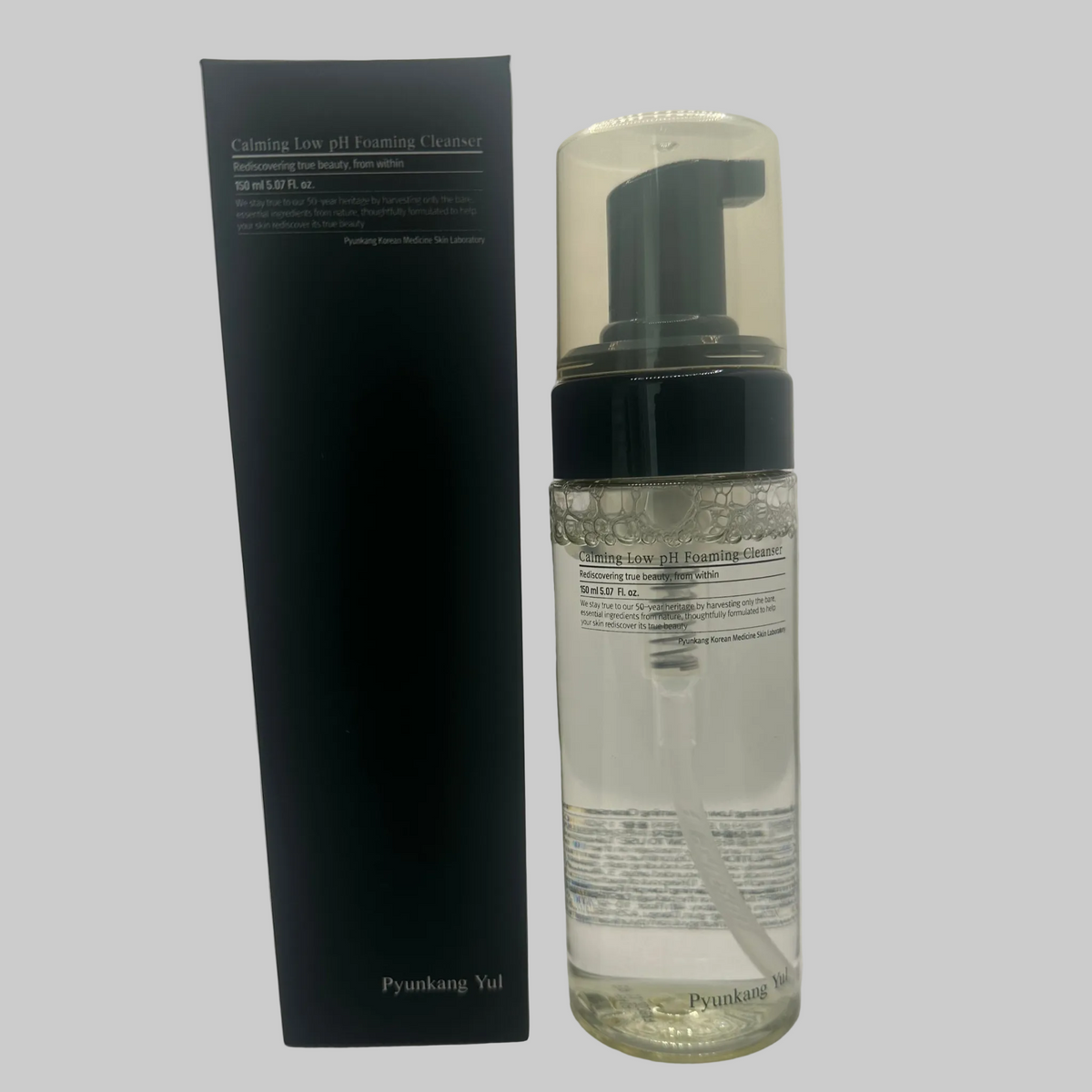
Pyunkang Yul Calming Low pH Foaming Cleanser 150ml
A gentle, low pH foaming cleanser built around Centella Asiatica and a five-type hyaluronic acid complex, alongside Tea Tree Leaf Extract and Willow Bark Extract for mild natural exfoliation.
Key ingredients
- Centella Asiatica Extract & Centelloids (Madecassoside, Asiaticoside, Madecassic Acid, Asiatic Acid) — well-established anti-inflammatory, barrier-supporting evidence
- Willow Bark (Salix Alba) Extract — naturally contains salicin, giving a mild exfoliating property
- Tea Tree (Melaleuca Alternifolia) Leaf Extract — traditionally used for its antimicrobial properties
- 5-type Hyaluronic Acid Complex — supports hydration
Best suited for
- Sensitive or oily/acne-prone skin wanting a gentle, low pH foaming cleanser
Screening summary
Out of 34 ingredients, 31 passed with no comments. The other three consisted of Disodium Laureth Sulfosuccinate which is a PEG/ethoxylated ingredient, Centella Asiatica Extract which may be a sensitiser for a very low number of users when high concentrations are used and Disodium EDTA, which is flagged for environmental reasons as it resists biodegradation in surface water once metal-bound.
A patch test is recommended before first use if you have known sensitivities to botanical extracts.
See the full ingredients, plain English translation and Screening results collapsible text for more information.
Every product here, including this one, is checked against our Ingredient Standards before it makes the cut.
Full ingredients list, plain English translations and screening results
|
INCI |
Plain English translation by Abevo |
Screening result |
|---|---|---|
|
Water |
Water |
✅ Passes |
|
Dipropylene Glycol |
Moisture-binding solvent |
✅ Passes |
|
Disodium Laureth Sulfosuccinate |
Gentle cleansing agent |
🟠 Passes - see below |
|
Disodium Cocoyl Glutamate |
Coconut-derived gentle cleanser |
✅ Passes |
|
Coco-Glucoside |
Coconut-derived gentle cleanser |
✅ Passes |
|
Polyglyceryl-10 Myristate |
Plant-derived emulsifier |
✅ Passes |
|
Camellia Japonica Flower Extract |
Camellia flower extract |
✅ Passes |
|
Centella Asiatica Extract |
Centella asiatica extract |
✅ℹ️ Passes - see below. |
|
Sodium Hyaluronate |
Hyaluronic acid (salt form) |
✅ Passes |
|
Lonicera Japonica (Honeysuckle) Flower Extract |
Honeysuckle flower extract |
✅ Passes |
|
Melaleuca Alternifolia (Tea Tree) Leaf Extract |
Tea tree leaf extract |
✅ Passes |
|
Salvia Officinalis (Sage) Leaf Extract |
Sage leaf extract |
✅ Passes |
|
Caprylic/Capric Triglyceride |
Coconut-derived lightweight oil |
✅ Passes |
|
Cetyl Ethylhexanoate |
Lightweight silky emollient oil |
✅ Passes |
|
Ethylhexyl Palmitate |
Lightweight silky emollient oil |
✅ Passes |
|
Hydrolyzed Hyaluronic Acid |
Hyaluronic acid (smaller molecule) |
✅ Passes |
|
Hydroxypropyltrimonium Hyaluronate |
Hyaluronic acid (conditioning form) |
✅ Passes |
|
Sodium Hyaluronate Crosspolymer |
Hyaluronic acid (cross-linked) |
✅ Passes |
|
Sodium Acetylated Hyaluronate |
Hyaluronic acid (film-forming) |
✅ Passes |
|
Madecassoside |
Centella/cica active compound |
✅ Passes |
|
Madecassic Acid |
Centella/cica active compound |
✅ Passes |
|
Asiaticoside |
Centella/cica active compound |
✅ Passes |
|
Asiatic Acid |
Centella/cica active compound |
✅ Passes |
|
Butylene Glycol |
Moisture-binding solvent |
✅ Passes |
|
Citric Acid |
pH adjuster |
✅ Passes |
|
Caprylyl Glycol |
Preservative booster/moisturiser |
✅ Passes |
|
Hydroxyacetophenone |
Plant-derived preservative booster |
✅ Passes |
|
Pentylene Glycol |
Moisture-binding preservative booster |
✅ Passes |
|
Salix Alba (Willow) Bark Extract |
Willow bark extract |
✅ Passes |
|
Polyquaternium-67 |
Conditioning polymer |
✅ Passes |
|
Propanediol |
Plant-derived moisture-binding solvent |
✅ Passes |
|
Ethylhexylglycerin |
Preservative booster/moisturiser |
✅ Passes |
|
Disodium EDTA |
Mineral-binder |
✅🟡 Passes - see below |
|
1,2-Hexanediol |
Plant-based preservative booster |
✅ Passes |
🟠 This cleanser contains a PEG/ethoxylated ingredient (Disodium Laureth Sulfosuccinate). As a rinse-off product, skin contact time is brief, which meaningfully limits absorption compared to leave-on formulations. Peer-reviewed toxicology review (Fruijtier-Pölloth, Toxicology, 2005) on ethoxylated cosmetic ingredients — the same chemistry used in this compound — finds this ingredient class safe for cosmetic use, while noting manufacturers must control for trace 1,4-dioxane and ethylene oxide byproducts. This product is manufactured in South Korea, where cosmetic regulation (MFDS) sets a legal maximum of 100ppm for unintentional 1,4-dioxane residue — a higher ceiling than the ≤10ppm level UK/EU regulators (via the Scientific Committee on Consumer Safety) treat as the threshold for an acceptable trace contaminant. We don't have brand-specific verification of the actual level in this product, so we're disclosing it as an open item — though rinse-off use meaningfully reduces the practical exposure this gap represents.
✅ℹ️ Contains Centella Asiatica Extract alongside all four isolated Centella constituents (Madecassoside, Madecassic Acid, Asiaticoside, Asiatic Acid) - this formulation pattern suggests a meaningfully high concentration. Centella Asiatica has been known to cause sensitisation in a very low number of individuals if exposed at a high level.
🟡 Environmental note: This product contains Disodium EDTA, which resists biodegradation in surface water once metal-bound.
A patch test is recommended before first use if you have known sensitivities to botanical extracts.
How to use - steps
Choose options